
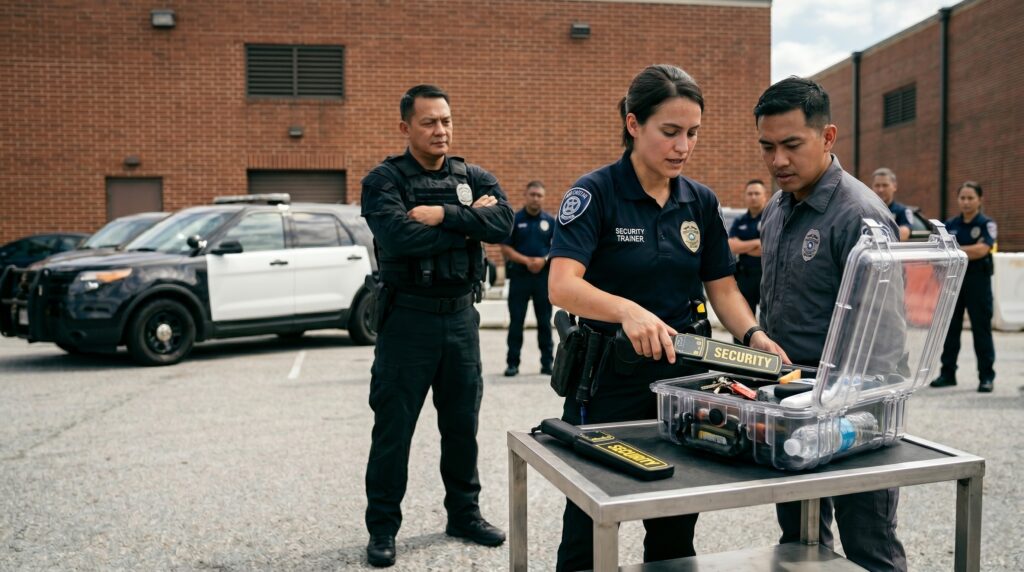
Security guard training in the Philippines is a rigorous, state-regulated process that goes far beyond putting on a uniform. While security personnel are a vital part of the daily landscape—securing the entry points of malls, corporate offices, financial institutions, and residential subdivisions—the stringent legal compliance required behind the scenes is often misunderstood. This comprehensive guide breaks down the legal frameworks, mandatory training hours, and licensing timelines required governing the industry today.
Key Takeaways: Security Guard Training & Licensing
If you are looking for a quick summary of the legal standards and training pipelines for private security in the Philippines under the current Republic Act No. 11917, here are the essential quick facts:
- The Governing Bodies: All private security training programs and licenses are strictly co-regulated by PNP-SOSIA (handling law enforcement standards, firearms, and licenses) and TESDA (handling skills and technical competency programs).
- Mandatory Entry Course: To enter the profession, new applicants must graduate from an accredited academy by completing the 150-hour Basic Pre-Licensing Training Course (PLTC).
- Extended License Validity: Under R.A. 11917, a valid License to Exercise Security Profession (LESP)—formerly known as a physical guard license—is valid for five (5) years from the date of issuance.
- Strict Renewal Requirements: License renewal requires clearing a mandatory 40-hour Security Refresher Training Course, alongside fresh physical, drug, and Neuro-Psychiatric test clearances.
- First Aid is Mandatory: All deployed guards must maintain active first aid and Basic Life Support (BLS) certificates, enabling them to act as critical first responders during emergencies.
- Limited Power of Arrest: Private security guards do not possess broad police arrest powers; they can only execute a citizen’s arrest for crimes committed directly within or adjacent to their assigned property boundaries.
Table of Contents
- What is Security Guard Training?
- Legal Requirements for Becoming a Security Guard
- Security Guard Training vs. Police Training
- Armed vs. Unarmed Security Operational Tracks
- Mandatory Emergency Response and First Aid Certification
- Licensing and Renewal Process
- Types of Security Guard Training Programs
- Common Misconceptions About Security Guards
- Why Security Guard Training in the Philippines Matters
- Frequently Asked Questions About Security Guard Requirements in the Philippines
What is Security Guard Training?
Security guard training is a structured program designed to prepare individuals for professional security work. It covers practical skills, legal responsibilities, and emergency response procedures.
In the Philippines, training is regulated through accredited agencies and security regulators such as the PNP Supervisory Office for Security and Investigation Agencies (PNP-SOSIA) and competency programs under the Technical Education and Skills Development Authority (TESDA).
This ensures that anyone entering the profession meets national standards before being deployed to client sites.
1. Legal Requirements for Becoming a Security Guard
To legally qualify for security guard training and licensing in the Philippines, applicants must meet the requirements under Republic Act No. 11917 (The Private Security Services Industry Act). This law modernized the private security industry and replaced the long-standing R.A. 5487.
The baseline qualifications for a Private Security License (PSL) include:
- Nationality: Must be a Filipino citizen.
- Age: At least 18 to 21 years of age.
- Education: Graduate of Senior High School (or equivalent under older curriculums).
- Clearances: Must pass mandatory Neuro-Psychiatric screening, drug testing, and obtain clearances from the NBI, PNP, and local courts.
Beyond the basic requirements, specialized deployments dictate distinct training pathways:
- Retail & Mall Security: Focused on customer service integration, loss prevention, bag inspection mechanics, and high-volume crowd management.
- Banking & Financial Security: Emphasizes high-risk access control, armored vehicle escorts, anti-bank robbery procedures, and firearm preparedness.
- Industrial & Infrastructure Protection: Tailored for logistics hubs, factories, and construction sites with a focus on inventory theft control, perimeter patrolling, and safety compliance.
- Executive Protection (VIP Security): Advanced instructional tracks covering threat assessment, defensive driving, close-quarter protection, and route reconnaissance.
Related: VIP Security: Protecting High-Profile Individuals
2. Security Guard Training vs. Police Training
The primary difference between security guard training and police training in the Philippines lies in their legal mandate and operational scope: police officers enforce public laws and investigate crimes, while security guards protect private assets and enforce property rules.
While police officers undergo rigorous tactical, criminal law, and public safety training at the Philippine National Police Academy (PNPA) or National Police Training Institute (NPTI), private security training is structured explicitly for corporate and private parameters:
| Operational Feature | Private Security Guard Training | PNP Police Officer Training |
| Legal Mandate | Republic Act No. 11917 | Republic Act No. 6975 & 8551 |
| Primary Core Focus | Crime prevention, asset protection, and access control within private property lines. | Active law enforcement, crime investigation, and public order maintenance nationwide. |
| Authority Scope | Arrests are limited to citizen’s arrests within assigned premises during an active crime. | Full statutory arrest, search, and seizure powers anywhere within Philippine territory. |
| Customer Service | High emphasis on public relations, visitor assistance, and client guidelines. | Focus on crowd suppression, tactical operations, and municipal order. |
3. Armed vs. Unarmed Security Operational Tracks
Private security personnel in the Philippines are funneled into either armed or unarmed operational tracks, each carrying significantly different training complexities and firearm certifications.
Armed Security Personnel
Guards designated to carry firearms must complete advanced tactical courses strictly monitored by PNP-SOSIA. This track includes:
- Comprehensive firearm safety and defensive handling mechanics.
- Mandatory live firing range qualifications and marksmanship testing.
- Strict legal orientation on the Use-of-Force Continuum to prevent unlawful firearm discharges.
- Mandatory registration of the specific firearm under the security agency’s Juridical License to Own and Possess Firearms (LTOPF).
Unarmed Security Personnel
Unarmed guards are trained intensively in observation, situational awareness, and de-escalation tactics. Instead of lethal weapons, their curriculum targets high-tech communication systems, logs, electronic access control, and specialized non-lethal defense tools.
Related: Armed vs. Unarmed Security Guards: Which Is Right For You?
4. Mandatory Emergency Response and First Aid Certification
Under national safety standards, all private security guards in the Philippines must hold a valid first aid and basic life support (BLS) certification before physical deployment. Because security guards are typically the closest personnel to an incident, they act as critical first responders.
Mandatory emergency training equips guards to execute:
- Cardiopulmonary Resuscitation (CPR): Immediate life-saving interventions during cardiac arrest or drowning incidents.
- Trauma Care: Managing puncture wounds, deep cuts, fractures, and stabilizing injured individuals using standard first aid kits.
- Evacuation Routing: Coordinating orderly building clearings during earthquakes, fires, or bomb threats in compliance with the Bureau of Fire Protection (BFP) guidelines.
Critical Takeaway: When a medical crisis or cardiac arrest occurs, every minute without intervention reduces the chance of survival by 7% to 10%. Performing immediate CPR within the first 4 minutes doubles or triples a victim’s odds of survival before an ambulance even arrives.
Related: 3 Reasons Why First Aid Training for Security Guards is a Must
5. Licensing and Renewal Process
A standard Private Security License (PSL) issued by PNP-SOSIA is valid for a maximum period of five (5) years and requires mandatory refresher courses to successfully renew.
Deploying a security guard with an expired license is a severe statutory violation that exposes both the security agency and the hiring client to steep regulatory fines and license revocations.
The standard renewal workflow requires the guard to undergo:
- A mandatory 40-hour Security Refresher Training Course.
- New physical, drug, and Neuro-Psychiatric clearances.
- Proof of clean compliance and deployment records.
Related: Understanding the Legal Aspects of Security Guard Services
6. Types of Security Guard Training Programs
The educational framework for private security in the Philippines features four distinct training courses tailored to a guard’s specific career tier.
- Basic Pre-Licensing Training Course (PLTC): A mandatory 150-hour foundational course covering security orientation, basic laws, first aid, courtesy, and discipline. This is a prerequisite for all new license applicants.
- Re-Training / Refresher Course: A 40-hour curriculum focusing on updated industry laws, advanced threat vectors, and a review of defensive tactics required every five years.
- Specialized Security Training Course: Custom, niche certifications mapping to complex target environments, including Aviation Security (AVSEC), Maritime Security (MARSEC), and Hotel/Hospitality protection.
- Security Supervisory Training Course: Designed for shift supervisors, detachments commanders, and security officers, focusing on risk assessment, crisis management, post administration, and leadership.
7. Common Misconceptions About Security Guards
Despite the important role security personnel play in maintaining safety, there are still several misconceptions about security guard training and what the profession involves.
Related: The 7 Most Common Misconceptions About Security Guards
They Receive the Same Training as Police Officers
While both professions contribute to public safety, their roles and training are different. Police officers are trained for law enforcement, investigations, and maintaining public order. Security guards, on the other hand, are trained to protect private properties, monitor activities, control access, and respond to incidents within assigned premises.
All Security Guards Carry Firearms
Not all security guards are armed. Only those who complete additional firearms training and meet licensing requirements are authorized to carry guns while on duty. Many security personnel work in unarmed roles focused on observation, reporting, and access control.
Security Work Does Not Require Formal Training
Some people assume security work is simple and does not require preparation. In reality, individuals must complete accredited training programs and secure proper licensing before they can be deployed as security personnel in the Philippines.
They Only Stand at Entrances
Security work involves much more than guarding entry points. Security personnel are also responsible for incident reporting, emergency response, visitor management, crowd control, and maintaining overall safety within their assigned areas.
Why Security Guard Training in the Philippines Matters
Security guard training in the Philippines is a structured and regulated process designed to ensure professionalism, safety, and reliability in the security industry.
From licensing requirements to specialized training programs, every step is designed to prepare guards for real-world responsibilities.
Frequently Asked Questions About Security Guard Requirements in the Philippines
How long does security guard training take in the Philippines?
The mandatory Basic Pre-Licensing Training Course requires 150 credit hours of classroom and practical instruction at an accredited academy. Periodic renewal retraining requires a shorter 40-hour course.
What government agency handles security guard licenses in the Philippines?
Private security licensing is strictly controlled by the Philippine National Police Supervisory Office for Security and Investigation Agencies (PNP-SOSIA), with technical training standards managed by TESDA.
How long is a security guard license valid in the Philippines?
Under modern regulations, a valid Private Security License (PSL) is valid for five (5) years from its date of issuance, after which the guard must clear refresher courses and background checks to renew.
Can a security guard make a legal arrest?
Yes, but only in specific cases allowed by law. A security guard may do so if a person is caught committing a crime, has just committed one, or is strongly suspected of it—within or near their assigned area. Outside of these situations, a security guard cannot make an arrest.
What are the main physical and mental health requirements for guards?
Applicants must pass a mandatory, standardized Neuro-Psychiatric Exam conducted by a PNP-accredited diagnostic center and return negative results on unexpected, comprehensive drug panels.
Looking for reliable protection? Explore our specialized security services for businesses across the Philippines today. Contact us today and we will be glad to offer you the best of our services!
Last Updated: July 2026
First Published: March 30, 2021

Camille J. covers a wide range of security topics, including professional security services, personnel training, and modern security solutions. She aims to present information in a clear and practical way, helping readers better understand the role security plays in today’s workplaces and communities.