
Security guard services are more than just a protective presence; they are a critical part of maintaining safety and order in today’s fast-paced world. Whether it’s a corporate building, gated subdivision, retail space, or public event, having trained and licensed security personnel ensures peace of mind and helps prevent threats before they escalate.
But beyond uniforms and duties, the security industry operates under strict laws and regulations designed to protect both clients and guards. Understanding these legal aspects is essential for security agencies, business owners, and anyone planning to hire security services in the Philippines.
Let’s explore the key legal requirements and responsibilities that shape the private security sector today.
Table of Contents
- Licensing and Accreditation Requirements
- Authority and Legal Limitations
- Proper Use of Force and Self-Defense
- Privacy and Confidentiality Privacy, Data Protection, and Confidentiality
- Liability, Insurance, and Risk Management
- Employment Rights and Labor Compliance
- Frequently Asked Questions About Security Guard Services in the Philippines
- Why Understanding the Legal Aspects of Security Guard Services in the Philippines Matters
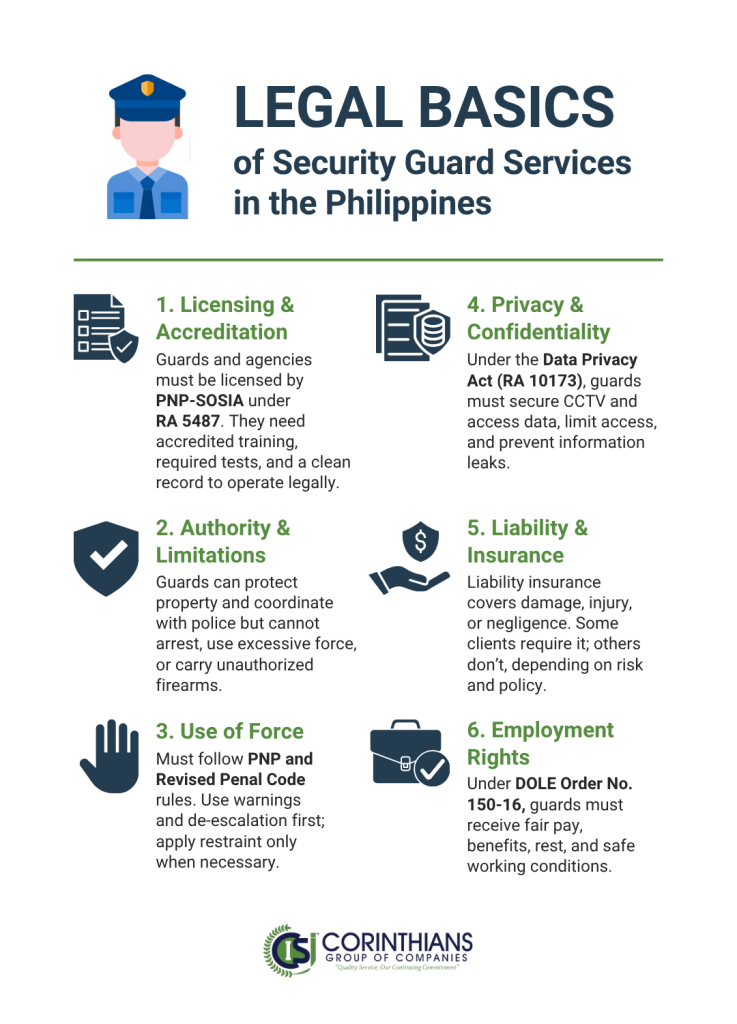
1. Licensing and Accreditation Requirements
Before any security agency or guard can legally operate, they must be licensed by the Philippine National Police–Supervisory Office for Security and Investigation Agencies (PNP-SOSIA).
To obtain a license, both the agency and individual security guards must meet the following requirements:
- Completion of accredited security training courses
- Updated Neuro-Psychiatric, Drug, and Physical Fitness tests
- Clean criminal record and valid government-issued IDs
- Compliance with the Republic Act No. 5487, also known as the Private Security Agency Law, and its 2022 implementing rules
Licensing ensures that all personnel are qualified, competent, and capable of protecting lives and property while upholding professional standards.
2. Authority and Legal Limitations
While security guards may seem like “law enforcers” on-site, their powers are limited by law. They have authority to:
- Protect property and maintain peace within their area of assignment
- Conduct reasonable questioning or detainment for probable cause
- Coordinate with local police when criminal acts occur
However, they cannot make formal arrests, carry high-caliber firearms without proper authorization, or use excessive force.
Understanding the scope of authority prevents both guards and clients from crossing legal boundaries, protecting everyone from potential lawsuits or violations
Related: The Must-Know Do’s and Don’ts for Security Guards
3. Proper Use of Force and Self-Defense
In situations involving danger or criminal activity, security guards are trained to respond with proportional and lawful force. This means:
- Using verbal warnings and de-escalation as the first response
- Employing physical restraint or defense only when absolutely necessary
- Avoiding lethal force unless life-threatening harm is imminent
All actions must comply with PNP guidelines and the Revised Penal Code on self-defense. Continuous refresher training on conflict management and the lawful use of force ensures guards act responsibly and protect the public without violating human rights.
Related: 5 Reasons Security Education and Training is Important for Security Guards
4. Privacy and Confidentiality Privacy, Data Protection, and Confidentiality
Today’s guards do more than physical security—they often handle CCTV systems, visitor logs, and access control data. Because of this, they must comply with the Data Privacy Act of 2012 (Republic Act No. 10173).
Security companies are expected to:
- Protect client and employee data from unauthorized access
- Limit sharing of CCTV footage and incident reports to authorized parties only
- Train personnel on data privacy compliance and confidentiality protocols
Maintaining privacy not only safeguards client trust but also prevents costly penalties from the National Privacy Commission.
5. Liability, Insurance, and Risk Management
EEven with trained personnel and proper systems, unforeseen incidents can happen—such as property damage, injuries, or theft.
That’s why reputable agencies carry comprehensive liability insurance to cover:
- Damages caused by guards during operations
- Accidents or injuries on-site
- Legal claims arising from negligence or misconduct
Important note: While some reputable agencies already have insurance coverage, some clients specifically require it as part of their contract, while others may not. It often depends on the nature of the project, site risks, or company policy.
6. Employment Rights and Labor Compliance
Security guards are entitled to the same labor protections as any employee under Philippine labor law. This includes:
- Proper wages and overtime pay under Department of Labor and Employment (DOLE) regulations
- Social benefits such as SSS, PhilHealth, and Pag-IBIG
- Safe working conditions and access to rest days
- Protection against unfair termination
Security companies must strictly comply with DOLE Department Order No. 150-16, which sets guidelines on contracting and employment standards for the private security industry.
Frequently Asked Questions About Security Guard Services in the Philippines
1. What are the legal requirements for security guard services in the Philippines?
All security agencies and guards must comply with Republic Act No. 5487, or the Private Security Agency Law. This includes obtaining a license from the Philippine National Police–Supervisory Office for Security and Investigation Agencies (PNP-SOSIA), completing accredited training programs, and passing background and medical checks.
2. Who regulates private security agencies in the Philippines?
Private security agencies are regulated by PNP-SOSIA, which monitors and enforces compliance with national standards. This agency is responsible for issuing licenses, accrediting training schools, and ensuring all guards and agencies operate legally and professionally.
3. Are security guards allowed to arrest someone?
Security guards have limited authority under Philippine law. They may perform a citizen’s arrest if a crime occurs in their presence or when a suspect is attempting to flee. However, guards must immediately hand over the person to the nearest police station as required by the Revised Penal Code.
4. What is a PNP-SOSIA license and why is it important?
A PNP-SOSIA license is proof that a security agency or guard is legally permitted to operate in the Philippines. It certifies that they have met the necessary qualifications, training, and documentation standards. Hiring unlicensed providers can expose clients to legal risks and invalid contracts.
5. How does the Data Privacy Act affect security guard operations?
Because security guards often manage CCTV systems, visitor logs, and access records, they must comply with the Data Privacy Act of 2012 (RA 10173). Agencies must ensure all personal and client data are stored securely, shared only when authorized, and used strictly for legitimate purposes.
6. What insurance coverage should security agencies have?
Security agencies are encouraged to maintain comprehensive liability insurance to cover property damage, accidents, or injuries that occur during duty. This protects both the agency and the client from potential legal and financial losses due to unforeseen incidents.
7. What labor laws apply to security guards in the Philippines?
Security guards are covered by the Department of Labor and Employment (DOLE) regulations, including fair wages, benefits (SSS, PhilHealth, Pag-IBIG), and safe working conditions. Agencies must also follow DOLE Department Order No. 150-16, which outlines fair contracting and employment practices in the private security industry.
8. How can clients verify if a security agency is licensed?
Before signing any contract, clients should:
- Request a copy of the agency’s PNP-SOSIA license
- Check for valid insurance and compliance documents
- Verify training certificates of assigned guards
- Confirm DOLE and privacy law compliance
NOTE: Working only with accredited and licensed security providers ensures legal protection and high service standards.
9. What are the penalties for operating without a license?
Operating a private security agency or deploying guards without a PNP-SOSIA license violates RA 5487 and may result in fines, business suspension, and possible imprisonment. Clients who knowingly hire unlicensed security providers can also face penalties for non-compliance.
Why Understanding the Legal Aspects of Security Guard Services in the Philippines Matters
Complying with the legal requirements for security guard services isn’t just about following rules; it’s about promoting accountability, professionalism, and safety in every operation. From obtaining the proper PNP-SOSIA licenses and understanding security guard authority and limitations, to ensuring data privacy, liability coverage, and fair labor practices, these legal foundations protect both clients and service providers.
For business owners and security agencies alike, staying updated on the latest laws and regulations ensures smooth operations and long-term trust. When you work with legally compliant and accredited security companies, you’re not only safeguarding your property; you’re also investing in a safer and more secure future for everyone.
Protect your business today—find trusted specialized security services in the Philippines that meet your unique needs. Contact us!
Last updated: November 21, 2025
First Published: June 30, 2023