
Businesses across different industries rely on security guards to help protect their employees, customers, property, equipment, and other valuable assets. The types of businesses that need security guards can vary depending on factors such as location, operating hours, foot traffic, the value of assets on-site, and the level of security risk involved.
While almost any business can benefit from professional security services, some industries have a greater need for on-site security because they handle valuable merchandise, sensitive information, large crowds, or high-risk activities.
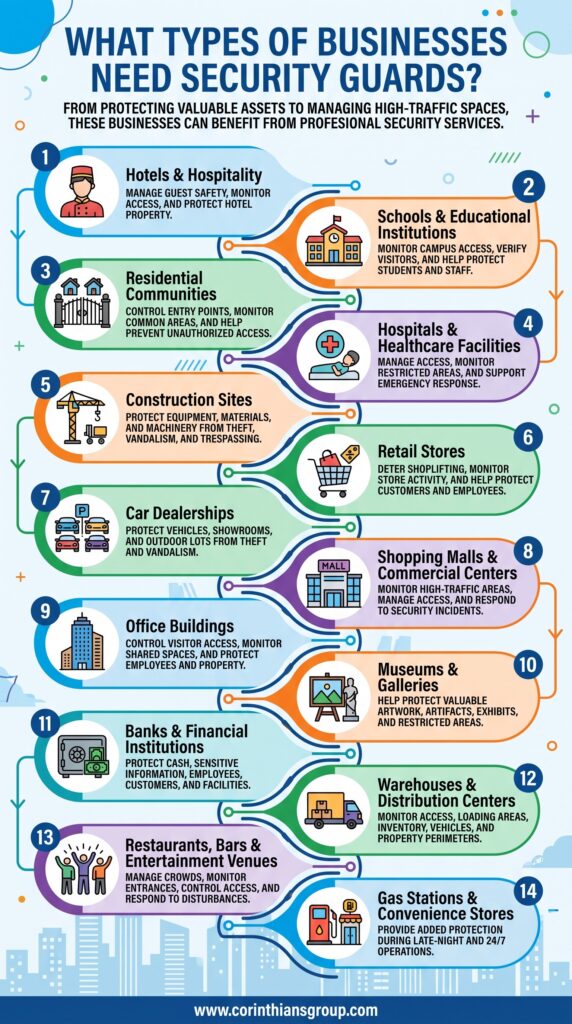
Here are some of the businesses that can benefit from hiring professional security guards.
Key Takeaways: What Types of Businesses Need Security Guards?
Businesses that need security guards typically fall into high-risk, high-traffic, high-value asset, or late-night operation categories to protect personnel, prevent theft, and control site access.
- High-Value & Inventory-Heavy Sites: Banks, financial institutions, retail stores, warehouses, car dealerships, and construction sites rely on security guards to prevent theft, unauthorized entry, and loss of expensive equipment or merchandise.
- High-Traffic & Public Facilities: Hotels, shopping malls, hospitals, educational campuses, and residential communities require on-site guards for crowd control, visitor verification, and access management.
- Cultural & Event Venues: Museums, art galleries, restaurants, bars, and entertainment venues hire security personnel to safeguard irreplaceable artifacts, manage large crowds, and resolve disruptive incidents.
- Extended-Hour & Nighttime Operations: 24/7 businesses like gas stations, convenience stores, and late-night commercial properties deploy guards to mitigate safety risks during low-visibility, off-peak hours.
- Businesses Facing High Operational Risks: Any enterprise with large physical footprints, high foot traffic, sensitive data, or a history of local crime needs tailored security coverage to protect employees, assets, and customers.
Table of Contents
- Hotels and Hospitality Establishments
- Schools and Educational Institutions
- Residential Communities and Condominiums
- Hospitals and Healthcare Facilities
- Construction Sites
- Retail Stores
- Car Dealerships and Automotive Businesses
- Shopping Malls and Commercial Centers
- Office Buildings
- Museums, Galleries, and Cultural Institutions
- Banks and Financial Institutions
- Warehouses and Distribution Centers
- Restaurants, Bars, and Entertainment Venues
- Gas Stations and Convenience Stores
- What Factors Determine if a Business Needs Security Guards?
- Why Should Businesses Hire Professional Security Guards?
- How Can Businesses Choose the Right Security Services?
- Conclusion: Protect Your Business With the Right Security Support
- Frequently Asked Questions About Types of Businesses That Need Security Guards
1. Hotels and Hospitality Establishments
Hotels have a constant flow of guests, employees, suppliers, and visitors throughout the day. With people coming and going at different hours, maintaining a safe and controlled environment can be challenging.
Security guards can monitor entrances, exits, lobbies, and common areas while helping identify unauthorized access and responding to security-related incidents. They can also conduct routine patrols, protect hotel property, and assist guests and staff during emergencies. For hotels in busy commercial and tourist areas, a visible security presence can provide guests with an added sense of safety while helping hotel management maintain an orderly environment.
Related: 6 Reasons Why Hotel Security is a Must
2. Schools and Educational Institutions
Schools, colleges, and universities accommodate large numbers of students, faculty members, staff, and visitors. Campuses can also cover large areas with multiple buildings, entrances, parking areas, and outdoor spaces, making security more challenging to manage.Security guards can monitor school entrances, verify visitors, conduct campus patrols, and assist during emergencies. They can also report suspicious activity and help maintain controlled access to restricted areas.
The appropriate level of security depends on the size of the campus, number of entry points, operating hours, and the school’s specific security requirements.
Related: Campus Security: 11 Ways to Improve Emergency Preparedness in Schools
3. Residential Communities and Condominiums
Residential properties such as subdivisions, condominium buildings, apartment complexes, and gated communities can benefit from having security guards on-site. With multiple residents, visitors, and service providers coming and going, maintaining controlled access can be challenging.
On-site security personnel can manage entrances and exits, verify visitors, patrol common areas, and monitor parking spaces. Their visible presence can also discourage unauthorized entry, theft, vandalism, and other security concerns, helping residents feel safer within the community.
In the Philippines, security guards are commonly deployed in residential communities and condominium developments, particularly in properties with controlled entrances and shared facilities.
Related: Choosing the Right Security Services for Your Residential Property in the Philippines
4. Hospitals and Healthcare Facilities
Hospitals operate 24/7, with patients, healthcare workers, visitors, suppliers, and emergency responders moving through the facility at different times. This constant activity, combined with the sensitive nature of healthcare environments, makes effective security an important part of hospital operations.
Having trained security personnel on-site helps manage access to restricted areas, oversee visitor movement, and respond to disturbances or other incidents. They can also assist during emergencies and keep watch over parking areas, entrances, and other high-traffic parts of the facility.
A combination of trained security personnel, CCTV cameras, alarms, access control systems, and established emergency procedures gives healthcare facilities a more comprehensive approach to safety.
Related: Helpful Ways to Improve Hospital Security
5. Construction Sites
Construction sites can be particularly vulnerable after working hours. Expensive machinery, tools, building materials, and equipment may remain on the property overnight, while unfinished structures can have multiple entry points that are difficult to secure.
Regular patrols and after-hours monitoring help keep these areas under watch. Security personnel can check people and vehicles entering the site, monitor the perimeter, and identify signs of trespassing or suspicious activity.
Overnight security becomes especially valuable when construction projects store expensive equipment and materials on-site or operate in locations with limited surrounding activity.
6. Retail Stores
From small shops to large retail establishments, stores have to protect merchandise while providing a comfortable experience for customers. High foot traffic can make it more difficult to spot suspicious behavior, particularly during busy shopping periods.
A security officer stationed on the premises can keep an eye on customer activity, entrances, exits, and other areas where incidents are more likely to occur. Their presence may discourage shoplifting and provide immediate support when a security concern arises. The appropriate level of coverage will depend on the store’s location, size, inventory, operating hours, and daily customer volume.
7. Car Dealerships and Automotive Businesses
A car dealership can have millions of pesos worth of vehicles sitting in an open display area, making the property an attractive target for theft and vandalism. Large lots can also be difficult to monitor, particularly after the showroom closes.
Security personnel can patrol vehicle displays and surrounding areas, keep track of activity around access points, and report anything unusual. During business hours, they can also contribute to a safer environment for customers and employees. CCTV cameras, proper lighting, alarms, and other security measures become even more effective when supported with an on-site security presence.
8. Shopping Malls and Commercial Centers
Shopping malls bring together hundreds of businesses and large numbers of shoppers, employees, contractors, and visitors under one roof. With such a high volume of activity, security requires more than simply monitoring the main entrance. Mall security teams help oversee common areas, entrances, exits, parking facilities, and other high-traffic locations.
They may also assist visitors, respond to disturbances, support emergency procedures, and coordinate with mall management when incidents occur. A consistent security presence helps maintain an orderly environment while giving tenants and shoppers greater confidence when using the facility.
Related: What are the Key Responsibilities of a Mall Security Guard?
9. Office Buildings
An office building may have employees arriving and leaving throughout the day, along with visitors, contractors, delivery personnel, and service providers. Without proper access controls, keeping track of everyone entering the property can become challenging.
Security personnel stationed at key access points can verify visitors, manage entry procedures, and help ensure that unauthorized individuals do not enter restricted areas. Regular patrols can provide additional oversight of the building, parking areas, and other shared spaces. Multi-tenant properties and offices that handle sensitive information may require additional security measures, particularly when employees work beyond standard business hours.
10. Museums, Galleries, and Cultural Institutions
Museums and galleries face a unique security challenge: protecting valuable and sometimes irreplaceable collections while allowing visitors to enjoy them freely. A single damaged or stolen artifact can result in significant cultural and financial loss.
Security personnel help maintain this balance through continuous observation of exhibits and visitor areas. They can enforce museum rules, prevent unauthorized handling of artifacts, monitor restricted spaces, and respond when a visitor or situation presents a potential risk. Museum staff can focus on exhibitions, visitor services, and preservation while trained security personnel provide an additional layer of protection for the collections.
11. Banks and Financial Institutions
Banks handle cash, financial records, confidential information, and valuable equipment, making security a fundamental part of their daily operations. Customers and employees also need to feel safe when entering and using the facility.
A security officer can oversee entrances, observe activity within the premises, assist with access control, and remain alert to suspicious behavior. In the event of a security incident, trained personnel can follow established procedures and coordinate with appropriate authorities. Physical security works alongside CCTV surveillance, alarms, access controls, and other technologies to create a stronger overall security system for financial institutions.
Related: The Importance of Security Guards in Banking Offices
12. Warehouses and Distribution Centers
Warehouses and distribution centers often cover large areas and handle significant quantities of inventory, equipment, raw materials, and finished products. The steady movement of employees, delivery vehicles, contractors, and suppliers can create multiple points that need monitoring.
Related: Warehouse Security: Why Is It Important?
Security personnel can oversee vehicle and pedestrian access, check deliveries, patrol loading areas, and keep watch over the property’s perimeter. After-hours coverage is also useful for facilities where valuable inventory remains on-site overnight. Large-scale operations can benefit from dedicated security coverage that protects inventory and supports access control without disrupting the movement of goods.
13. Restaurants, Bars, and Entertainment Venues
Busy restaurants, bars, clubs, concert venues, and event spaces can experience significant increases in foot traffic during evenings, weekends, holidays, and special events. Large crowds can make it more difficult for employees to handle security concerns while managing their regular responsibilities.
Security personnel can take on responsibilities such as monitoring entrances, managing access, observing crowd activity, and responding to disruptive behavior. At larger events, they can also help direct people and support established emergency procedures. Late-night establishments and venues that regularly host large crowds can benefit from professional security that helps maintain a controlled and comfortable environment for customers and staff.
14. Gas Stations and Convenience Stores
Gas stations and convenience stores often have extended operating hours, with some remaining open 24 hours a day. Employees may therefore work late-night shifts when there are fewer customers and less activity around the property.
During these periods, having security personnel on-site provides an additional layer of oversight. They can patrol the premises, monitor entrances and parking areas, observe activity around fuel pumps, and report suspicious behavior. An on-site security presence can be particularly valuable during quieter hours, helping employees and customers feel safer while the business remains open.
What Factors Determine if a Business Needs Security Guards?
Not every business requires the same level of security. Several factors can help determine whether a company needs security personnel and how much coverage may be appropriate.
1. Location
Businesses operating in areas with higher security concerns may require additional protection. The surrounding environment and the property’s accessibility can influence potential security risks.
2. Operating Hours
Businesses that operate overnight or 24/7 may need security coverage outside regular working hours. Late-night operations can leave employees, customers, and property more vulnerable when fewer people are present.
3. Value and Type of Assets
The type and value of assets kept on-site can affect security requirements. Businesses that handle cash, vehicles, inventory, equipment, machinery, or sensitive documents may need stronger protection.
4. Customer and Visitor Volume
High-traffic establishments often require additional security to help manage large numbers of people. Hotels, hospitals, shopping malls, schools, and entertainment venues are examples where crowd management and access control can be important.
5. Property Size and Layout
Large properties with multiple buildings, entrances, parking areas, or perimeter access points can be more difficult to monitor. Additional security personnel may be necessary to provide adequate coverage across the entire premises.
6. Previous Security Incidents
A history of theft, vandalism, unauthorized access, or other security incidents may indicate a need for stronger security measures. Businesses should consider past incidents when assessing their current vulnerabilities.
7. Existing Security Systems
CCTV cameras, alarms, access control systems, and proper lighting can strengthen a property’s security. However, these technologies may be more effective when supported by trained personnel who can monitor activity, assess situations, and respond according to established procedures.
Why Should Businesses Hire Professional Security Guards?
Security guards provide more than a visible presence. Depending on their assignment and training, they can help businesses monitor their premises, manage access, respond to incidents, protect property, and assist employees and customers.
Some of the main benefits include:
- Crime deterrence: A visible security presence can discourage theft, vandalism, unauthorized access, and other unwanted activity.
- Access control: Security guards can monitor who enters and exits a property and follow established visitor procedures.
- Emergency support: Trained personnel can follow established procedures during security incidents and emergencies.
- Asset protection: Guards can monitor merchandise, equipment, vehicles, facilities, and other valuable property.
- Employee and customer safety: Security personnel can help maintain a safer environment for people on-site.
- Peace of mind: Businesses can focus on daily operations while designated security personnel handle assigned security responsibilities.
Security guards should complement, rather than replace, other security measures such as CCTV systems, alarms, access control, proper lighting, and emergency procedures.
How Can Businesses Choose the Right Security Services?
The right security service depends on the business, its location, daily operations, and potential risks. A retail store may prioritize theft prevention and access monitoring, while a construction site may need overnight patrols and perimeter protection.
Before choosing a security provider, consider these key factors:
1. Assess the Property’s Security Risks
Identify vulnerable areas, access points, previous security incidents, and valuable assets that require protection. This assessment can help determine the type and level of security needed.
2. Determine the Required Coverage
Consider the property’s size, operating hours, number of entrances, and areas that need regular monitoring. Decide whether the business requires full-time, part-time, overnight, or 24/7 security coverage.
3. Check Security Guard Training
The guards assigned to the property should have the appropriate training and skills for the environment. Requirements may differ between a corporate office, residential community, hospital, retail store, or construction site.
4. Review the Security Provider’s Qualifications
Look for an established security company with properly licensed and qualified personnel. Reviewing the provider’s experience and track record can also help businesses make a more informed decision.
5. Clarify the Scope of Services
Make sure the agreement clearly outlines what the security team is expected to handle. Services may include access control, property patrols, visitor monitoring, incident reporting, and emergency support.
6. Evaluate Communication and Reporting
Reliable communication is essential when dealing with security concerns. Ask how incidents are reported, who receives updates, and how the security team communicates with business management during emergencies or other situations.
Conclusion: Protect Your Business With the Right Security Support
The types of businesses that need security guards can range from hotels and retail stores to schools, hospitals, construction sites, warehouses, banks, and entertainment venues. However, there is no one-size-fits-all approach to business security.
The right solution depends on the property’s location, size, operating hours, assets, foot traffic, and potential security risks. A construction site may require overnight patrols, while a hotel may need access control and continuous monitoring. A shopping mall, meanwhile, may require a larger team to manage high visitor traffic and respond to incidents.
Professional security guards can provide an important layer of protection alongside CCTV cameras, alarms, access control, proper lighting, and established emergency procedures. With the right security coverage, businesses can create a safer environment for employees, customers, visitors, and valuable assets.
Frequently Asked Questions About Types of Businesses That Need Security Guards
What types of businesses need security guards?
Hotels, schools, residential communities, hospitals, construction sites, retail stores, car dealerships, shopping malls, office buildings, museums, banks, warehouses, restaurants, entertainment venues, and gas stations can all benefit from professional security guards. The level of protection needed depends on the business’s location, operations, property, assets, and security risks.
Do small businesses need security guards?
Yes. Small businesses can also benefit from professional security services, particularly if they handle valuable inventory, operate during late hours, have experienced security incidents, or require additional protection for employees and customers. Depending on the business, security coverage may be full-time, part-time, scheduled, or mobile.
Can security guards replace CCTV cameras?
No. Security guards and CCTV systems serve different purposes. Cameras provide visual monitoring and recorded footage, while security personnel can assess situations, communicate with people on-site, respond to incidents, and follow established procedures. Using both can provide a more comprehensive approach to security.
How many security guards does a business need?
There is no standard number that applies to every business. The required number depends on factors such as property size, number of entrances, operating hours, customer traffic, security risks, and areas requiring continuous monitoring. A professional security assessment can help determine appropriate coverage.
Are security guards only needed for businesses with high-value assets?
No. Security guards can help protect employees, customers, visitors, facilities, and property in addition to valuable assets. Businesses with high foot traffic, large premises, extended operating hours, or specific safety concerns may benefit from security services even if they do not handle expensive merchandise or equipment.
Looking for trusted specialized security services in the Philippines? Contact our team today for a security solution tailored to your business.
Last Updated: September 2026
First Published: April 30, 2022

Camille J. covers a wide range of security topics, including professional security services, personnel training, and modern security solutions. She aims to present information in a clear and practical way, helping readers better understand the role security plays in today’s workplaces and communities.